

The first eight weeks of a puppy’s life are the most fragile — and the most closely watched. Whether you’re helping a mother dog raise her litter or hand-raising an orphaned puppy, knowing what’s normal at each stage makes the difference between a smooth start and a missed warning sign. This guide walks through newborn puppy care from birth to weaning, including temperature, feeding, weight gain, and the milestones to track along the way.
The First 24 Hours
A healthy newborn puppy should be nursing within the first two hours of birth. This early nursing matters more than almost anything else in the first day — the mother’s first milk, called colostrum, delivers antibodies the puppy cannot get any other way. A puppy that misses colostrum in the first 24 hours has a much weaker immune system for the following weeks, since a newborn’s own immune system isn’t functional yet and depends entirely on what it receives through nursing in this narrow window.
In the first day, expect puppies to do very little besides nurse and sleep. Movement is limited to slow crawling toward warmth and the mother’s body — true walking is still weeks away. Crying should be brief and should stop once the puppy is warm, fed, and touching littermates or the mother. Prolonged crying, especially from a puppy that keeps moving away from the group or away from the mother, is worth watching closely, since it often signals the puppy isn’t getting enough warmth or milk.
It also helps to count the litter regularly in the first day or two, confirming every puppy is nursing and none has been pushed to the edge of the pile. In larger litters, a mother dog can’t always keep track of every puppy at once, and a puppy that ends up on the outside of the group is at higher risk of chilling.
Keeping Newborn Puppies Warm
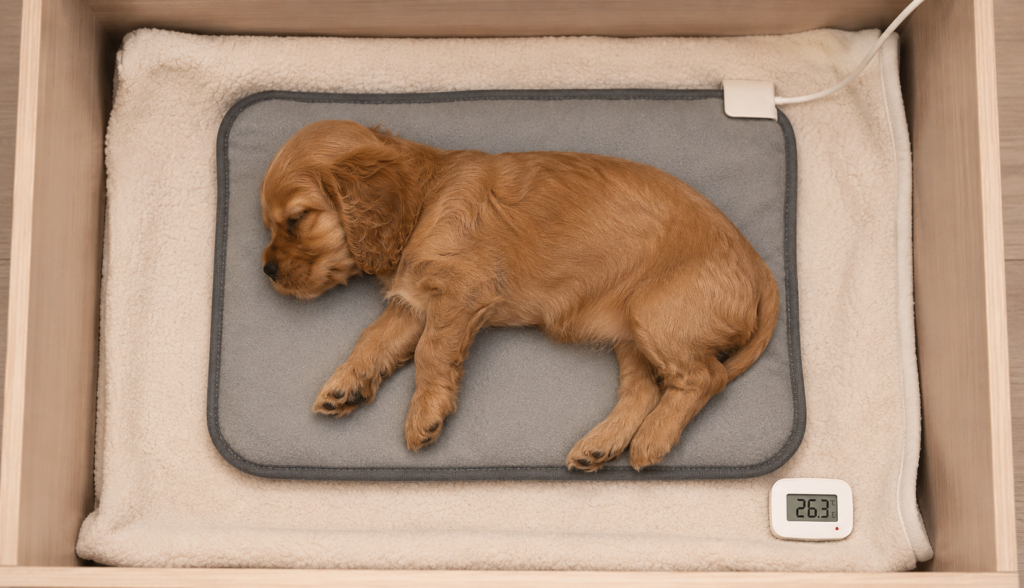
Newborn puppies cannot regulate their own body temperature for roughly the first two to three weeks of life. This is one of the most common points where new or first-time breeders run into trouble — a chilled puppy will stop nursing, and a puppy that stops nursing chills further, creating a fast downward spiral.
| Puppy Age | Target Nursery Temperature |
|---|---|
| Days 1–7 | 85–90°F (29–32°C) |
| Days 8–14 | 80°F (27°C) |
| Days 15–21 | 75°F (24°C) |
| After week 4 | Room temperature is generally fine |
A whelping box with a heating pad set to low, covered so the puppies can move off it if they get too warm, works well. Never place a heat source where a puppy cannot crawl away from it — the goal is a gradient, not a single fixed hot zone.
Feeding Schedule and Weight Gain
Newborn puppies nurse frequently — roughly every two hours around the clock for the first week, tapering to every three to four hours by weeks two and three. A puppy that sleeps through more than four to five hours without nursing in the first two weeks should be checked.
Weight is the single best indicator that things are going well. Puppies should gain weight daily from birth. A general guideline is that a puppy should roughly double its birth weight by day 10. Daily weigh-ins with a kitchen scale, logged and compared, catch problems early — well before visible signs appear.
If a puppy is not gaining weight, is noticeably smaller than littermates, or feels cool to the touch, these are the earliest signs of what’s sometimes called fading puppy syndrome — a term for a newborn puppy that is failing to thrive for reasons that can range from low birth weight to infection to inadequate nursing. Early veterinary involvement gives the best chance of turning things around, and outcomes are generally much better when a vet is involved on day one or two of noticing a problem rather than after several days of watching and waiting.
It’s worth noting that a certain amount of size variation within a litter is completely normal — not every puppy needs to be identical in weight. What matters is the trend for each individual puppy: steady daily gains, even if one puppy is consistently smaller than its littermates, are usually fine. A flat or declining trend on the scale is the real warning sign, not a puppy simply being on the smaller end of the litter.
Orphaned or Rejected Puppies: Bottle Feeding Basics
Sometimes a mother dog cannot nurse — due to a large litter, illness, or in rare cases refusing a particular puppy. In these situations, a commercial puppy milk replacer (never cow’s milk, which puppies cannot digest properly) and a small feeding bottle designed for puppies become necessary.
Bottle-fed puppies need to be fed on a schedule similar to nursing — roughly every two to three hours in week one, gradually spacing out. They also need help with elimination, since a mother dog normally stimulates puppies to urinate and defecate by licking them. A warm, damp cloth gently rubbed on the puppy’s lower abdomen after each feeding replicates this and should continue until the puppy can eliminate on its own, usually around three weeks.
Developmental Milestones (Week by Week)
| Age | What to Expect |
|---|---|
| Birth | Eyes and ears closed; relies entirely on smell and touch; crawling only |
| Week 2 | Eyes begin opening (around days 10–14); still mostly sleeping and nursing |
| Week 3 | Ears open; first wobbly steps; beginning to react to sound and light |
| Week 4 | Walking more steadily; baby teeth emerging; interest in solid food begins |
| Weeks 5–6 | Active play with littermates; weaning underway; personality becoming visible |
| Weeks 7–8 | Mostly weaned; ready for first vet visit, first vaccinations, and eventually rehoming |
What Most People Don’t Know
Most new owners assume a quiet, sleeping litter is a good sign — and it usually is. But a newborn puppy that is completely silent and unresponsive, even when handled, is more concerning than one that fusses briefly. Healthy newborns should show some reflexive protest — squirming, small sounds — when picked up or examined. A puppy that goes fully limp and silent, sometimes called a “floppy” puppy, needs immediate veterinary attention rather than being left to rest.
Another overlooked detail: the umbilical cord should dry up and fall off on its own within a few days, typically without any intervention needed. It should not be pulled, cut shorter, or treated with anything unless a vet specifically advises it — most complications come from unnecessary handling, not from leaving it alone.
Weaning Onto Solid Food
Weaning typically begins around three to four weeks of age and finishes by six to eight weeks. Start with a gruel made from puppy food softened with warm water or puppy milk replacer, offered in a shallow dish alongside continued nursing. Gradually thicken the mixture over several weeks as the puppy shows more interest in eating on its own and nursing naturally decreases.
This is also the window when the first deworming typically happens — most vets recommend starting around two weeks of age and repeating every two weeks through the early months, since puppies commonly receive parasites from their mother even in clean environments. This is normal and expected rather than a sign that anything went wrong with the litter’s care, and a vet can confirm the right product and schedule for the puppy’s age and weight.
Expect the weaning process to be messy — puppies typically step in the food, paw at it, and end up wearing more than they eat in the first several days. This is a normal part of learning to eat solid food and isn’t a cause for concern. By six to eight weeks, most puppies are eating moistened kibble or a soft puppy food confidently on their own, with nursing dropping off naturally as the mother also becomes less willing to nurse a growing, more mobile litter.
When to See a Vet
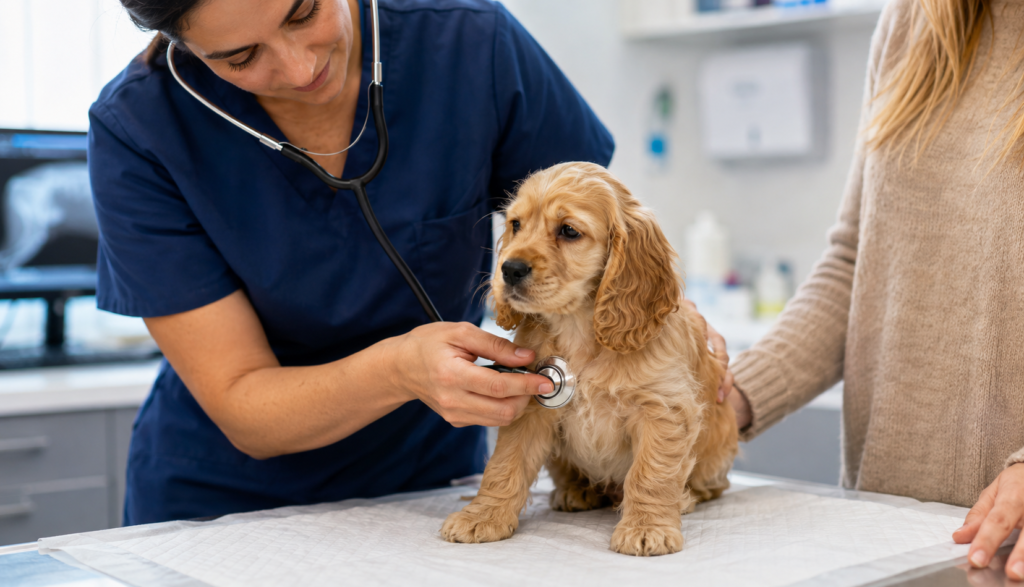
A first veterinary check is generally recommended around six to eight weeks, in line with the first vaccinations. Outside of that schedule, contact a vet sooner if a puppy shows any of the following: no weight gain over 24–48 hours, persistent crying that doesn’t resolve with warmth and feeding, difficulty breathing, a cold body temperature that doesn’t improve, or refusal to nurse for more than a few hours in the first two weeks. With newborn puppies, problems escalate quickly, and early intervention has a far better success rate than waiting to see if things improve on their own.
Frequently Asked Questions
Q. How often do newborn puppies need to eat?
A. Roughly every two hours in the first week, whether nursing or bottle-feeding, tapering to every three to four hours by weeks two and three.
Q. When do puppies open their eyes and ears?
A. Eyes typically open between days 10 and 14. Ears usually follow shortly after, around day 14 to 21.
Q. How do I know if a newborn puppy is gaining weight properly?
A. Daily weigh-ins are the most reliable method. A puppy should gain weight every day and roughly double its birth weight by around day 10.
Q. What temperature should a newborn puppy nursery be?
A. 85–90°F for the first week, gradually decreasing to room temperature by around four weeks, since puppies cannot regulate their own body heat early on.