
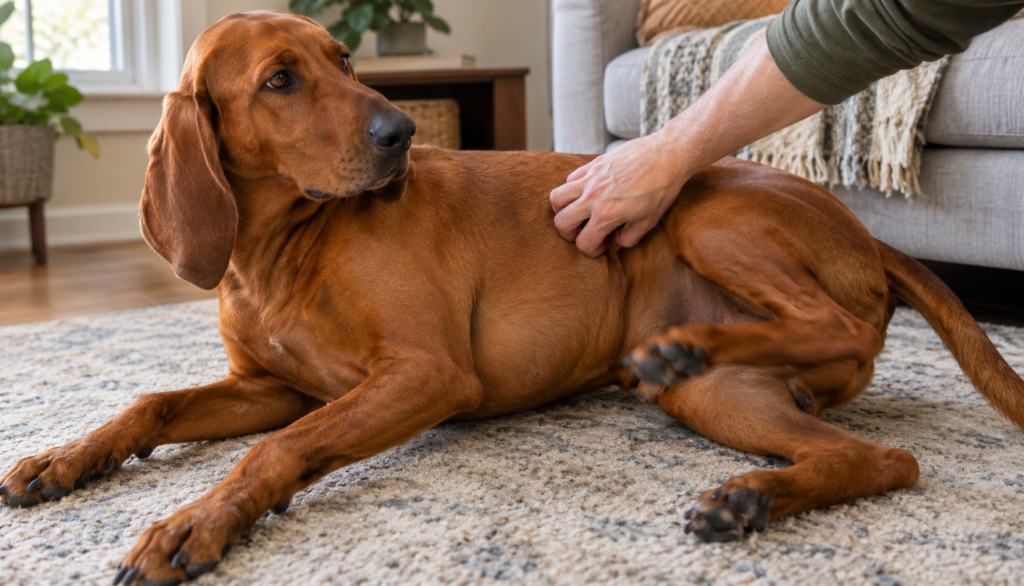
Have you ever scratched your dog’s belly or side and noticed one of its hind legs kicking rapidly? This common behavior can look funny, especially when your dog seems comfortable and relaxed. If you have a Redbone Coonhound, you might notice the movement when scratching certain areas along its side, chest, or belly.
The reason behind this movement is usually the scratch reflex, an involuntary response controlled by the nervous system. When you touch a sensitive area, nerves send signals that trigger a kicking motion in the hind leg. Although this reaction is normal, it does not automatically mean your dog enjoys the scratching. Sometimes, repeated kicking can also be associated with itching or skin irritation.
Understanding the difference can help you recognize when your dog is simply reacting to a sensitive spot and when it might need attention.
Why Do Dogs Kick Their Leg When You Scratch Them?
Dogs often kick their hind leg when scratched because of an automatic neurological response known as the scratch reflex. This reflex can occur when you rub or scratch a particular area of the dog’s skin, especially around the belly, sides, chest, or flank.
When your fingers stimulate sensitive nerve endings in the skin, those nerves send signals through the spinal cord. The nervous system then activates muscles in the hind leg, producing a repeated kicking or scratching movement.
Your dog does not consciously decide to move its leg in this situation. The response can happen automatically, even when the dog is lying comfortably on its side.
For example, if you gently scratch the side of a Redbone Coonhound while it is resting on a rug, you might notice its rear leg moving rhythmically. This is a typical example of the scratch reflex.
The response varies between individual dogs. Some kick vigorously after a few seconds of scratching, while others show little or no movement.
What Is the Scratch Reflex in Dogs?
The scratch reflex is an involuntary movement that helps a dog respond to certain sensations on its skin. It is part of the nervous system’s protective response to stimulation that may resemble an itch or irritation.
When a sensitive area is stimulated, sensory nerves carry signals to the spinal cord. Neural circuits then activate muscles that move the hind leg toward the stimulated area.
This response can happen without the dog consciously thinking about it. It is similar to other automatic reflexes in animals, although the specific movements and triggers differ.
The scratch reflex is not exclusive to domestic dogs. Related reflexes occur in other mammals, too.
Importantly, the presence of this reflex does not prove that the skin is itchy, nor does it confirm that the dog is enjoying the experience. It simply shows that the nervous system is responding to a particular type of touch.
Why Do Certain Spots Make Dogs Kick More?
Some areas of a dog’s body are more likely to trigger the scratch reflex than others. The response depends on the location of sensory nerves, individual sensitivity, and the type of touch.
Belly and Chest
The belly and chest can be sensitive areas, particularly when a dog is lying on its side or back. Gentle scratching in these locations may stimulate the nerves responsible for the reflex.
However, not every dog likes having its belly touched. A dog that rolls over may be inviting interaction, seeking a comfortable position, or simply stretching. Look at its overall body language before assuming it wants a belly rub.
Sides and Flanks
The flanks are the areas along the sides of the body, between the ribs and hips. Scratching these areas can trigger the hind-leg movement in some dogs.
A Redbone Coonhound’s short, smooth coat makes its skin relatively easy to reach during gentle petting. Nevertheless, the breed does not have a unique scratch reflex; individual dogs of many breeds respond similarly.
Behind the Ears and Around the Neck
Some dogs enjoy gentle rubbing around the neck and behind the ears. These areas can also be sensitive to touch, although scratching them does not necessarily trigger the hind-leg reflex.
Watch for signs that your dog wants more contact, such as leaning into your hand, remaining relaxed, or voluntarily returning for attention.
If touching the ears or neck causes persistent scratching, head shaking, pain, or unusual sensitivity, an underlying skin or ear problem may need to be investigated.
Does Your Dog Enjoy Being Scratched When Its Leg Kicks?
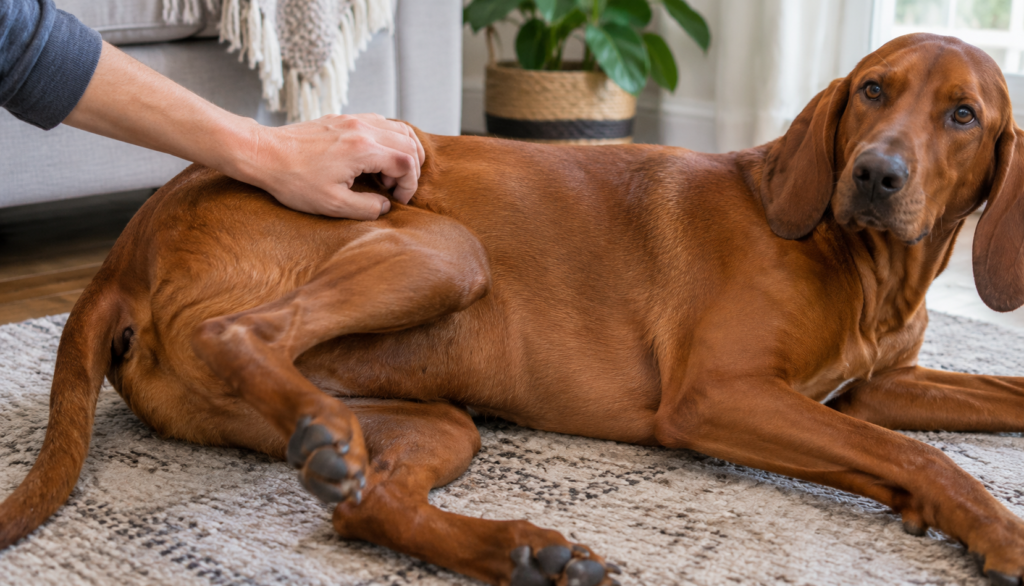
Not necessarily. A kicking leg is an automatic response, so it cannot tell you on its own whether your dog finds the scratching pleasant.
Some dogs enjoy gentle scratching and remain relaxed throughout the interaction. Others may tolerate it even when they would prefer you to stop.
To understand how your dog feels, pay attention to its entire body rather than focusing only on the moving leg.
Signs your dog may be comfortable include a loose body posture, relaxed facial muscles, soft eyes, and voluntarily moving closer to your hand. Some dogs may lean into the scratching or return when you briefly stop.
Signs your dog may be uncomfortable include stiffening, turning its head away, repeatedly licking its lips, showing the whites of its eyes, trying to move away, or growling.
A useful approach is to stop scratching briefly and see what your dog does. If it moves closer or nudges your hand, it may want more interaction. If it walks away or appears tense, give it space.
Never assume that a dog enjoys being scratched simply because its leg starts kicking.
Is the Scratch Reflex Normal in Redbone Coonhounds?
Yes. Redbone Coonhounds can display the same scratch reflex seen in other dog breeds.
Redbone Coonhounds are athletic scent hounds known for their rich red coats, long ears, and strong tracking instincts. Their breed characteristics do not mean they have a fundamentally different scratch reflex.
An individual Redbone Coonhound may kick its hind leg when scratched along the flank, chest, or belly, while another may show little response to the same touch.
The location and intensity of the response depend on the individual dog’s sensitivity and the specific area being stimulated.
If your Redbone Coonhound seems comfortable, responds normally to gentle touch, and has no other signs of itching or discomfort, occasional reflexive kicking is generally nothing to worry about.
However, if the behavior has recently started, becomes unusually intense, or occurs alongside persistent scratching or skin changes, consider whether irritation or another health issue could be involved.
When Does Leg Kicking Indicate Itching or Skin Irritation?
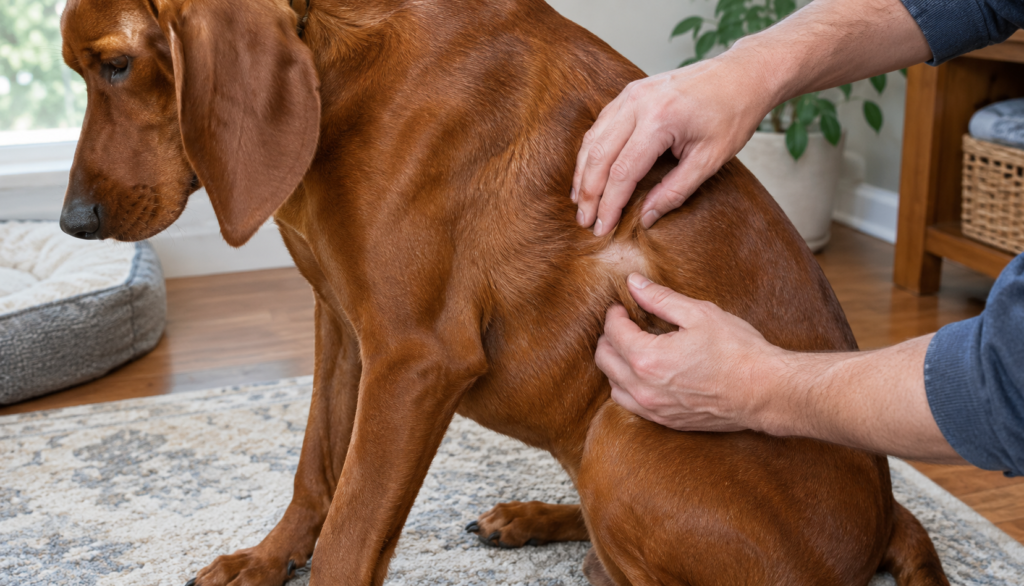
Although the scratch reflex is usually normal, repeated leg movements can sometimes occur alongside a genuine itch or an irritated patch of skin.
The important distinction is whether the kicking happens only when you touch a particular spot or whether your dog is frequently scratching, licking, biting, or rubbing itself throughout the day.
Fleas and Other Parasites
Fleas can cause significant itching, particularly around the lower back, base of the tail, and hindquarters. Some dogs develop an allergic reaction to flea bites, making even a small number of fleas uncomfortable.
Other parasites can also cause skin irritation. If your dog scratches persistently or develops hair loss, scabs, or visible skin changes, a veterinarian can help identify the cause.
Environmental or Food Allergies
Allergies can contribute to recurring itching in dogs. Depending on the cause, a dog may scratch its body, lick its paws, rub its face, or develop recurrent ear problems.
Allergies cannot be diagnosed from leg kicking alone. A veterinary examination may be necessary to distinguish allergies from parasites, infections, and other skin conditions.
Dry or Irritated Skin
Dry skin, contact irritation, or inflammation can make certain areas more sensitive than usual. Excessive bathing, unsuitable grooming products, and environmental factors may contribute to some skin problems.
Avoid applying human creams or medicated products without veterinary guidance. Some ingredients may irritate the skin or be unsafe if licked.
Skin Infection or Localized Pain
Bacterial or yeast infections can cause itching, redness, an unpleasant odor, or changes in the skin. In some cases, tenderness or pain can also make a dog react strongly when touched.
If your dog suddenly flinches, cries out, snaps, or guards a particular area when scratched, stop touching the spot. Painful reactions deserve veterinary attention rather than repeated attempts to trigger the reflex.
How to Tell the Difference Between a Normal Reflex and a Problem
The timing and surrounding symptoms can help you decide whether the behavior is likely to be a normal response or a sign that something needs attention.
A normal scratch reflex generally occurs when you scratch a particular spot and stops when you stop touching that area. The dog otherwise behaves normally and does not appear to have persistent itching.
A possible skin problem is more likely when the dog scratches repeatedly without being touched, chews or licks the same area, develops redness or hair loss, or seems unusually sensitive.
Arrange a veterinary appointment if itching persists, the skin becomes inflamed, or your dog develops recurring ear or skin problems. Seek prompt care for severe pain, rapidly worsening swelling, open wounds, or signs of a serious allergic reaction.
Do not keep scratching an irritated area to see whether the leg kicks. Doing so may worsen discomfort.
Should You Scratch Your Dog’s Sensitive Spots?
You can gently scratch your dog if it appears comfortable and welcomes the contact. The key is to let your dog’s behavior guide the interaction rather than trying to produce the kicking reflex.
Start with gentle strokes and avoid applying pressure to the belly, joints, or any area that appears painful. Briefly pause to see whether your dog chooses to remain close or seeks more attention.
If the dog moves away, stiffens, growls, or shows other signs of discomfort, stop.
You should also avoid repeatedly triggering the reflex just for entertainment. Even if the movement looks amusing, the dog may experience the sensation differently from how you interpret it.
If scratching consistently causes unusual sensitivity, persistent itching, or discomfort, have the area checked instead of continuing to rub it.
Frequently Asked Questions
Why does my dog’s leg kick when I scratch its belly?
Scratching a sensitive area can activate the canine scratch reflex. Nerve signals travel to the spinal cord and trigger automatic movement in the hind leg. The response is involuntary and does not necessarily indicate pleasure.
Do dogs feel ticklish when you scratch them?
Dogs can be sensitive to touch, and some respond to particular sensations with reflexive movements. However, it is difficult to equate a dog’s experience directly with human ticklishness. The kicking response is better understood as a neurological reflex.
Why does my dog kick when I scratch its side but not its belly?
Different areas of the skin have different patterns of sensory stimulation, and individual dogs vary in sensitivity. Your dog may have a stronger scratch reflex along its flank than around its belly. This difference is usually normal if there are no other symptoms.
Should I worry if my dog kicks its leg every time I scratch it?
Occasional kicking triggered by scratching a specific spot is generally normal. It becomes more concerning if the dog also scratches constantly, develops skin changes, seems painful, or starts reacting differently to ordinary touch.
Why does my dog scratch itself even when I am not touching it?
Repeated self-scratching may be caused by fleas, allergies, skin irritation, infections, or other conditions. If the behavior is frequent or persistent, arrange a veterinary examination to identify the cause.
Does a Redbone Coonhound have a stronger scratch reflex than other dogs?
There is no established reason to assume Redbone Coonhounds universally have a stronger scratch reflex than other breeds. Individual sensitivity varies, so one dog may kick noticeably while another barely reacts.
Final Thoughts
Dogs kick their legs when scratched because stimulation of certain areas of the skin can trigger an automatic neurological response known as the scratch reflex. It is a normal behavior that occurs in many dogs, including Redbone Coonhounds.
However, the movement does not automatically mean a dog enjoys being scratched. Pay attention to body language, stop if your dog appears uncomfortable, and watch for persistent itching or changes in the skin.
Understanding the difference between a normal reflex and ongoing irritation helps you respond to your dog’s needs while keeping scratching and petting comfortable.