
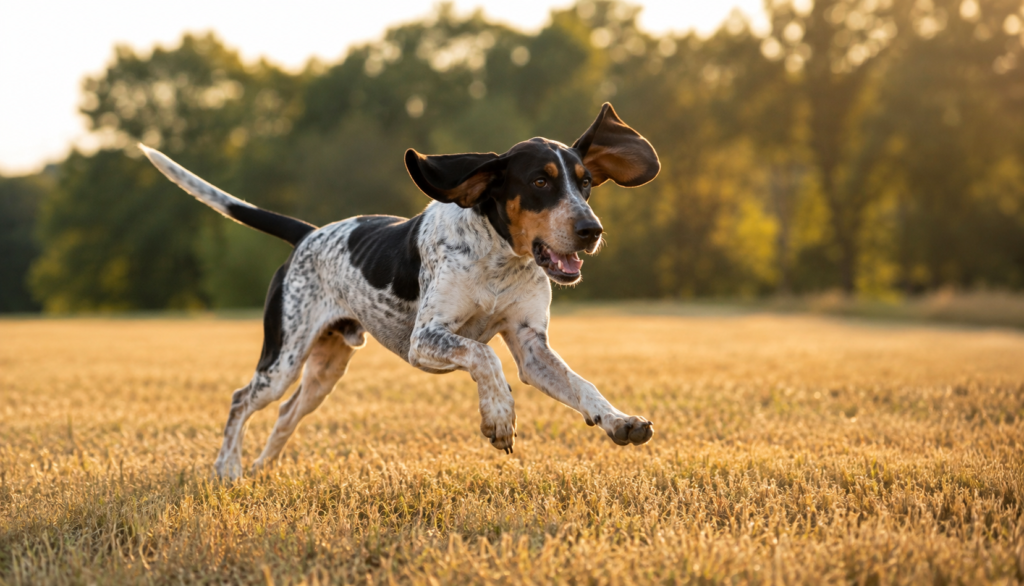
The old “multiply by 7” rule for converting dog years to human years is wrong, and it’s not even close. A one-year-old dog isn’t 7 in human terms — she’s closer to 15, already through puppyhood and into adolescence. The real math depends on your dog’s size, breed, and age, and it changes at every life stage. Below you’ll find the updated conversion charts vets actually use, broken down by dog size, along with what each age range really means for your dog’s health and care.
Dog Age to Human Years Chart (By Size)
Because small breeds mature fast but live long, while large breeds mature fast and age faster overall, a single formula can’t capture every dog. The American Veterinary Medical Association (AVMA) and multiple veterinary aging studies now use size-adjusted charts instead of a flat multiplier. Here’s the breakdown:
| Dog’s Age | Small Breed (up to 20 lbs) | Medium Breed (21–50 lbs) | Large Breed (51–90 lbs) | Giant Breed (90+ lbs) |
|---|---|---|---|---|
| 1 year | 15 | 15 | 14 | 12 |
| 2 years | 24 | 24 | 22 | 22 |
| 3 years | 28 | 28 | 31 | 31 |
| 4 years | 32 | 32 | 38 | 38 |
| 5 years | 36 | 36 | 45 | 49 |
| 6 years | 40 | 42 | 50 | 56 |
| 7 years | 44 | 47 | 55 | 64 |
| 8 years | 48 | 51 | 61 | 72 |
| 9 years | 52 | 56 | 66 | 81 |
| 10 years | 56 | 60 | 72 | 91 |
| 11 years | 60 | 65 | 77 | — |
| 12 years | 64 | 69 | 82 | — |
| 13 years | 68 | 74 | 88 | — |
| 14 years | 72 | 78 | 93 | — |
| 15 years | 76 | 83 | — | — |
| 16 years | 80 | 87 | — | — |
Notice the gaps at the older ages for large and giant breeds. That’s not a formatting error — it reflects a real biological fact: giant breeds rarely live past 10–12 years, while small breeds routinely reach 15 or 16. Size doesn’t just change the conversion math, it changes the entire lifespan curve.
Why the “Multiply by 7” Rule Is Wrong
The 7-year rule assumes dogs age at a constant, linear rate for their entire lives and that all breeds age identically. Neither is true. Dogs mature far faster than humans in their first two years, then the aging rate slows and levels off. A 2-year-old dog isn’t 14 in human terms under modern science — she’s closer to 24, having already passed through the equivalent of the teenage years and into early adulthood.
The flat multiplier also ignores size entirely, which is backwards from how aging actually works in dogs. In humans, being larger doesn’t shorten lifespan. In dogs, it’s one of the strongest predictors of how fast the aging clock runs.
The origin of the “times 7” rule isn’t even clear, and no veterinary body ever endorsed it as scientifically accurate. The most common explanation is that it came from a rough assumption that humans live to about 70 and dogs live to about 10, so someone divided one by the other and the number stuck in pop culture. It was never based on biological data about how dogs actually age — it was a marketing-friendly shortcut that happened to spread widely enough to become “common knowledge.” That’s part of why it persisted for decades despite being so far off at both ends of a dog’s life: it was never tested against real aging markers, just repeated.
The Science Behind Size-Based Aging
Research published in the journal Cell Systems (2020) analyzed DNA methylation patterns — chemical changes to DNA that accumulate with age — in Labrador retrievers and found that dog aging follows a logarithmic curve, not a straight line. Translated into plain terms: aging is fast early, then slows down. That study is also the source of the widely cited formula: human age = 16 × ln(dog’s age in years) + 31, which tracks closely with the chart above for medium-sized dogs.
Separately, longevity research across hundreds of breeds has consistently found an inverse relationship between size and lifespan in dogs — larger dogs tend to age faster at the cellular level and have shorter life expectancies overall, likely tied to accelerated cell growth and higher rates of age-related disease in bigger bodies.
What Each Life Stage Actually Means for Your Dog

Converting age into a “human number” is fun, but the more useful takeaway is what each stage means for care, vet visits, and what to watch for.
Puppy Stage (0–1 Years)
This is the fastest developmental window of your dog’s life. Bones, teeth, vision, and the immune system are all maturing rapidly, which is why puppies need frequent vet checkups, a full vaccination schedule, and calorie-dense puppy-formula food rather than adult food.
Adolescent Stage (1–3 Years, Varies by Size)
Physically mature or nearly so, but behaviorally still developing. This is when many training regressions and testing-boundaries behaviors show up — the canine equivalent of the teenage years. Large and giant breeds mature more slowly through this window than small breeds.
Adult Stage (3–7 Years for Most Breeds)
The stable middle years. Metabolism, energy, and health markers tend to plateau. Annual wellness exams remain important even though dogs at this stage usually look and act healthy — early markers of joint, dental, or organ issues often don’t show visible symptoms yet.
Senior Stage (7+ Years, Earlier for Giant Breeds)
Giant breeds are typically considered senior by 6, while small breeds may not hit this stage until 10 or later. Senior dogs benefit from twice-yearly vet visits, bloodwork to catch kidney or thyroid changes early, joint-support supplements, and adjusted calorie intake to prevent weight gain as activity naturally declines.
What Most People Don’t Know
Most people assume the conversion works the same in reverse — that you can take a dog’s “human age” and predict exactly how many dog years are left. But because the aging curve is logarithmic rather than linear, the back-and-forth math only works cleanly in one direction. A far more useful number than any converted age is your dog’s individual breed life expectancy and body condition score, since two dogs with the same converted “human age” can be in very different health positions depending on genetics, weight, and preventive care history.
It’s also not widely known that spaying or neutering measurably affects the aging timeline itself, not just behavior. Multiple studies have found spayed and neutered dogs tend to live longer on average than intact dogs of the same breed, which shifts where they land on any age-conversion chart over their lifetime.
How to Estimate Your Mixed-Breed Dog’s Age Equivalent
For mixed breeds, use your dog’s weight as the sizing guide rather than trying to average out parent breeds. A 35-pound mixed-breed dog should reference the medium-breed column regardless of what breeds are in the mix, since weight — not breed identity — is what actually drives the aging-rate differences described in the research above.
This matters most for dogs whose adult weight is genuinely uncertain, like rescues adopted as adults with no known history. In that situation, a vet can estimate age using dental wear, joint condition, and coat changes far more accurately than any chart can from weight alone. Use the chart as a starting reference point for care planning, not as a substitute for an actual veterinary age estimate when the dog’s history is unknown.
Do Certain Breeds Age Differently Than Their Size Predicts?
Size is the strongest predictor of aging rate, but it isn’t the only one. Some breeds are outliers relative to their weight class. Certain sighthounds, for example, are medium-to-large in size but have documented respiratory and cardiac aging patterns that differ from other breeds of similar weight. Brachycephalic breeds — those with short, flat muzzles like Bulldogs and Pugs — often show age-related breathing complications earlier than the general chart would predict, regardless of their otherwise small-to-medium size classification.
This is why breed-specific research matters alongside the general size chart. If your dog belongs to a breed known for a particular hereditary condition, that condition’s typical onset age is often a more useful planning number than the generic conversion chart, since it points to exactly what a vet should be screening for and when.
When to See a Vet Regardless of “Human Age”

Age conversion charts are a helpful mental model, not a diagnostic tool. Watch for these signs at any age and bring them to a vet promptly rather than attributing them to “just getting older”:
- Sudden changes in appetite, thirst, or weight
- New lumps, bumps, or growths
- Stiffness, limping, or reluctance to jump or climb stairs
- Increased confusion, disorientation, or changes in sleep patterns
- Noticeable decline in vision or hearing
- Bad breath alongside drooling or difficulty chewing
Many of these are treatable or manageable when caught early, and none of them should be dismissed simply because a chart says your dog is “still young” in human terms.
It’s also worth building a habit of comparing your dog against her own baseline rather than against the chart. A dog who suddenly sleeps far more than she used to, or who used to bound up the stairs and now hesitates, is showing you something meaningful even if her converted “human age” still sounds young. Age charts are population averages; your dog’s own trajectory over the past six to twelve months is a far more sensitive signal than any single number on a table.
FAQ
Q. Is the “1 dog year = 7 human years” rule accurate?
A. No. It assumes dogs age at a constant rate their whole lives, which isn’t true. Dogs mature much faster in their first two years, then aging slows down — a pattern that follows a logarithmic curve, not a flat multiplier.
Q. How do I convert my dog’s age if she’s a mixed breed?
A. Use her weight, not her breed mix, as the sizing guide. A 35-pound mixed-breed dog should reference the medium-breed column on the chart, since weight is the main driver of aging-rate differences.
Q. At what age is a dog considered a senior?
A. It depends heavily on size. Giant breeds are often considered senior by age 6, medium breeds around 7-8, and small breeds not until 10 or later.
Q. Why do large dogs age faster than small dogs?
A. Research points to accelerated cellular aging and higher rates of age-related disease in larger bodies. It’s the opposite of the human pattern, where size doesn’t affect lifespan the same way.