

A pregnant dog’s nutritional needs change dramatically over her roughly nine-week gestation, and feeding her the same way she ate before pregnancy can leave her undernourished right when her body needs the most support. The right approach isn’t a single “pregnancy food” — it’s a shifting plan that tracks her changing calorie, protein, and calcium needs as she moves through early, middle, and late pregnancy, and into nursing.
This guide breaks down exactly what to feed a pregnant dog at each stage, how much, how often, and which common feeding mistakes to avoid.
Why Pregnant Dogs Need a Different Feeding Approach
During pregnancy, a dog’s body is building placental tissue, growing multiple puppies, and preparing mammary glands for milk production — all of which require significantly more energy and specific nutrients than maintenance feeding provides. Her stomach capacity also shrinks as puppies take up abdominal space, which is why feeding frequency matters as much as feeding amount.
Protein and calorie needs rise steadily, but not evenly — the increase is minimal in early pregnancy and steep in the final third. Feeding a flat, unchanging amount throughout pregnancy either underfeeds her in late pregnancy or overfeeds her early on, both of which carry risks.
It also helps to think of pregnancy feeding as a moving target rather than a fixed switch you flip once. A dog carrying two puppies has very different needs than one carrying eight, and litter size usually isn’t confirmed until an ultrasound partway through pregnancy. This is part of why vets recommend adjusting food gradually and checking in as pregnancy progresses, rather than committing to one rigid plan on day one and following it blindly through whelping.
Breed size matters too. Small and toy breeds often need proportionally more calories relative to their body weight during pregnancy than large breeds do, since they tend to have smaller, more frequent litters but higher relative metabolic demands. Large and giant breeds, meanwhile, need portion increases managed carefully to avoid excessive weight gain that can complicate whelping. None of this means the guidelines below need to be abandoned — it just means treating them as a framework to adjust with a vet’s input, not a one-size-fits-all prescription.
First Trimester (Weeks 1–3): Little to No Change
In the first three weeks, embryos are still microscopic and caloric needs barely increase over her normal maintenance diet. Continue her regular high-quality adult food at her usual portion — there’s no need to switch foods or increase volume yet.
Some dogs experience a brief dip in appetite around week 3, sometimes called “morning sickness,” tied to hormonal shifts. This is usually mild and self-resolving within a few days. If she skips meals for more than 24–48 hours or seems lethargic, a vet check is warranted.
Second Trimester (Weeks 4–6): Begin the Transition
Around week 4, it’s time to start increasing food gradually and consider transitioning toward a nutrient-denser formula. Many vets recommend switching to a high-quality puppy food during this window, since puppy formulas are calorically concentrated and higher in protein, calcium, and fat — closely matching what a pregnant dog now needs.
Make any food transition gradual over 5–7 days, mixing increasing amounts of the new food with the old to avoid digestive upset. By week 6, caloric intake should be modestly increased over baseline, split across two meals a day rather than one large one.
Third Trimester (Weeks 7–9): Peak Nutritional Demand
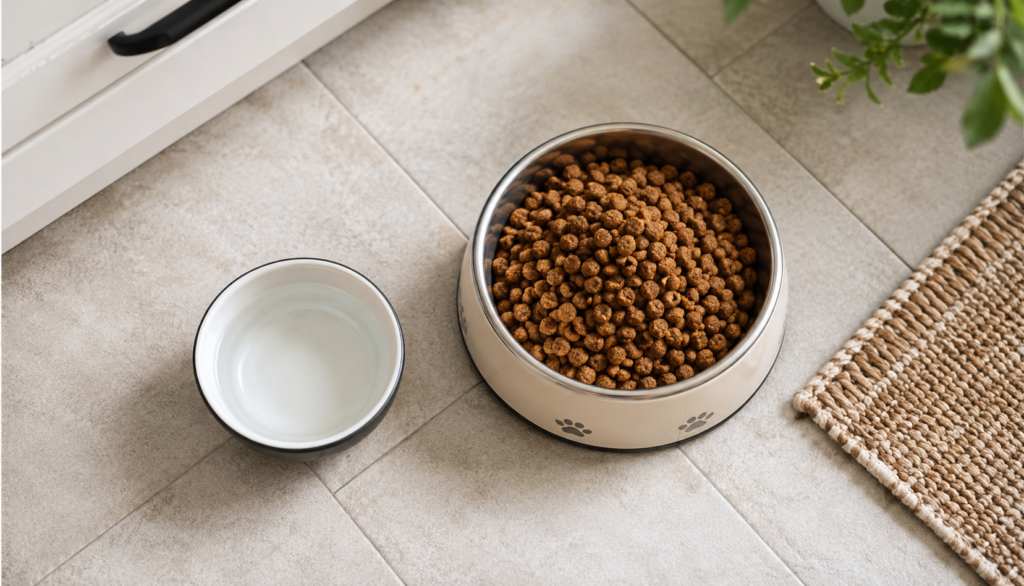
This is when energy needs rise fastest. By the final two weeks, many pregnant dogs need noticeably more food than their pre-pregnancy baseline, reflecting the rapid growth of puppies in the last stretch. Exact amounts vary by breed, litter size, and body condition, so this is a good point to confirm portions with a vet rather than estimating alone.
As her abdomen fills with puppies, stomach capacity drops further. Move to three or four smaller meals a day instead of one or two larger ones — this keeps her comfortable and helps maintain steady blood sugar, which matters more as whelping approaches.
Feeding Frequency by Stage
| Stage | Meals Per Day | Food Type |
|---|---|---|
| Weeks 1–3 | 1–2 (normal routine) | Regular adult maintenance food |
| Weeks 4–6 | 2 | Transitioning to puppy or pregnancy-formulated food |
| Weeks 7–9 | 3–4 small meals | Puppy or high-calorie pregnancy formula |
| Nursing period | Free-feeding or 4+ meals | Puppy food, highest calorie density |
Protein, Calcium, and the Nutrients That Matter Most
Protein is the building block for fetal tissue, placental development, and eventual milk production, so a pregnant dog’s diet should run higher in protein than standard adult maintenance food — another reason puppy food, which is formulated for growth, works well during pregnancy.
Calcium deserves special attention, but not in the way many owners assume. Adding calcium supplements during pregnancy is generally discouraged, because it can disrupt the dog’s natural calcium regulation and increase the risk of eclampsia (dangerously low blood calcium) after whelping, when milk production suddenly demands large amounts of calcium. A complete, high-quality puppy food already contains appropriately balanced calcium — additional supplementation should only happen under direct veterinary guidance.
Omega-3 fatty acids (such as DHA from fish oil) support fetal brain and eye development and are worth discussing with a vet as a potential addition, particularly for larger breeding programs.
Fat content also deserves attention alongside protein. A moderate increase in dietary fat helps meet the higher energy demands of pregnancy without requiring impractically large meal volumes, since fat is more calorie-dense than protein or carbohydrate. This is another reason puppy formulas tend to work well during pregnancy — they’re typically formulated with a higher fat percentage than standard adult maintenance diets, built for a life stage with similarly elevated energy needs.
Folic acid is another nutrient worth knowing about, particularly in the first few weeks when neural tissue is forming. Most complete, high-quality commercial dog foods already provide adequate folic acid, so supplementation typically isn’t necessary unless a vet identifies a specific deficiency or the dog is on a home-prepared diet that needs closer nutritional balancing.
What Most People Don’t Know
Most owners assume a pregnant dog needs “more of everything” from day one, but overfeeding in early pregnancy is one of the most common mistakes. Excess weight gain in the first few weeks doesn’t help the puppies — they’re still tiny — and it can make labor harder and increase the risk of complications from an overweight dam. The real nutritional demand is backloaded toward the final third of pregnancy and the nursing period that follows, which is when calorie needs climb the most sharply.
Another overlooked detail: switching a pregnant dog abruptly to a rich, high-calorie food can trigger diarrhea or vomiting at exactly the wrong time. Slow transitions aren’t just a general best practice here — they’re a safeguard against a dog going into labor already dehydrated or run-down from a week of digestive upset.
Foods and Feeding Mistakes to Avoid
- Raw or unpasteurized diets: Increased risk of bacterial infection (Salmonella, Listeria) that can harm both the dam and developing puppies.
- Unsupervised calcium or vitamin supplements: Can disrupt natural hormonal regulation — only add under veterinary direction.
- Sudden food switches: Always transition gradually, even between two high-quality foods.
- Table scraps and inconsistent treats: Can unbalance a carefully formulated diet and introduce unnecessary calories or unsafe ingredients.
- Restricting food due to weight concerns: Pregnancy is not the time for calorie restriction, even in dogs who were overweight beforehand — this should only be managed by a vet.
- Low-quality or filler-heavy foods: Pregnancy is a poor time to economize on food quality — a dog’s system is already working harder, and diets high in fillers and low in usable protein make it harder to meet rising nutritional demands without overloading her stomach.
- Human vitamin supplements: Prenatal vitamins made for people are formulated for human physiology and dosing, and are not a safe substitute for a properly balanced dog food or vet-directed supplement.
It’s also worth noting that most of these mistakes come from good intentions — owners wanting to do everything possible to support a healthy litter. The safest version of that instinct is usually the simplest: a high-quality, complete commercial food fed in gradually increasing amounts, with any additions run past a vet first rather than added independently.
When to Call the Vet About Feeding or Appetite
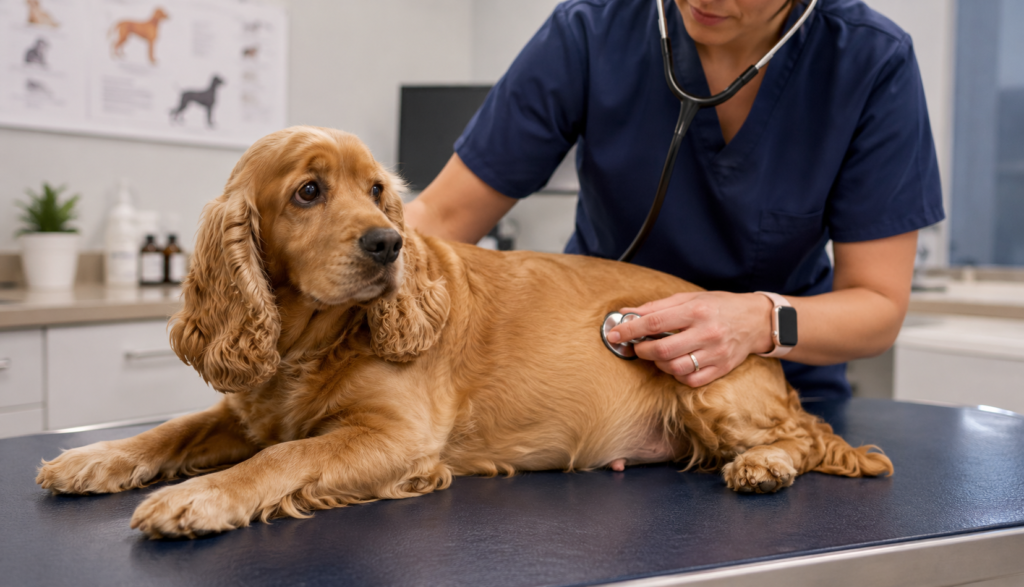
A pregnant dog refusing food for more than a day, vomiting repeatedly, or losing weight during pregnancy needs veterinary attention promptly. A sudden, complete loss of appetite in the final week can also be an early sign of labor approaching, so it’s worth noting the timing alongside other labor signs rather than assuming it’s purely a feeding issue.
Feeding After Whelping (Nursing Period)
Caloric needs peak during nursing, often exceeding pregnancy-level intake, since milk production is more energy-demanding than pregnancy itself. Free-feeding high-quality puppy food, or offering four or more meals a day, is standard during this window. Fresh water availability becomes even more critical, since nursing significantly increases fluid needs.
FAQ
Q. Can a pregnant dog eat her regular adult food the whole time?
A. Only in the first few weeks. By mid-pregnancy, most dogs benefit from transitioning to a higher-calorie, higher-protein puppy or pregnancy-formulated food to meet rising nutritional demands.
Q. Should I give my pregnant dog calcium supplements?
A. Not without veterinary guidance. Unsupervised calcium supplementation during pregnancy can actually increase the risk of low blood calcium (eclampsia) after whelping.
Q. How many meals a day should a pregnant dog eat?
A. Early pregnancy can stay on her normal 1–2 meal routine. By the third trimester, 3–4 smaller meals a day is more comfortable as stomach capacity shrinks.
Q. Is it normal for a pregnant dog to lose her appetite?
A. A brief dip around week 3 is common and usually harmless. Loss of appetite lasting more than a day, or appearing suddenly in the final week, should be checked by a vet.