
Quick answer: No. Dogs shouldn’t eat marshmallows. Regular marshmallows aren’t toxic but offer no nutritional value and pose a choking hazard, while sugar-free marshmallows can contain xylitol — a sweetener that is severely toxic to dogs and can be fatal within hours.
If your dog just snatched a marshmallow off the counter or begged one from a campfire s’more, you’re probably wondering how worried you should actually be. The honest answer depends entirely on one thing: whether that marshmallow contains xylitol. This guide walks through exactly what happens when dogs eat marshmallows, which situations are genuine emergencies, and what a safer treat looks like instead.

Are Marshmallows Toxic to Dogs?
Traditional marshmallows made from sugar, corn syrup, gelatin, and water are not classified as toxic to dogs. A single regular marshmallow swallowed by a 50-pound dog is unlikely to cause a medical emergency. That said, “not toxic” is not the same as “safe” or “recommended.” Marshmallows are essentially pure sugar with no protein, fiber, vitamins, or minerals a dog’s body can use — they’re empty calories at best.
The real danger lies in a growing category of marshmallows that food manufacturers now produce as “sugar-free,” “keto,” or “diet” alternatives. These often substitute sugar with xylitol, a sugar alcohol that is completely safe for humans but extremely dangerous for dogs.
The Xylitol Danger: Why Sugar-Free Marshmallows Are a Real Emergency
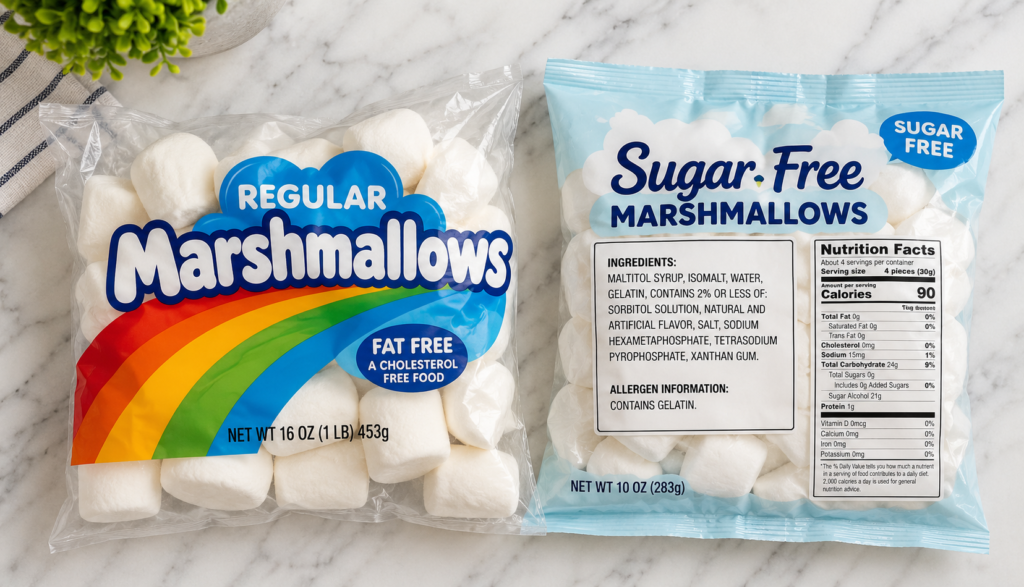
If your dog ate a sugar-free or “no sugar added” marshmallow, treat this as a potential emergency.
Xylitol triggers a rapid, dangerous insulin release in dogs (but not in humans), causing blood sugar to crash. In higher doses it can also cause acute liver failure. Symptoms can appear within 10–60 minutes and include vomiting, weakness, wobbliness or loss of coordination, tremors, seizures, and collapse. Even a small amount can be dangerous depending on the dog’s size and the xylitol concentration in the product.
Always check the ingredient label before assuming a marshmallow is “just sugar.” Xylitol is increasingly common in low-sugar and diabetic-friendly candy, and packaging doesn’t always make it obvious at a glance.
If you suspect xylitol ingestion: Call your veterinarian, an emergency animal hospital, or the ASPCA Animal Poison Control Center immediately. Do not wait for symptoms to appear — early treatment dramatically improves outcomes. Do not induce vomiting unless a professional specifically instructs you to.
What Happens If a Dog Eats a Regular (Non-Xylitol) Marshmallow?
One or two regular marshmallows are generally not a cause for panic. Most dogs will be completely fine, though some may experience mild, short-lived stomach upset from the sudden sugar load — soft stool, gas, or mild lethargy. Dogs with diabetes, obesity, or pancreatitis history should avoid marshmallows entirely, since even sugar (without xylitol) can worsen those conditions.
Watch your dog for the next few hours regardless of which type they ate. If symptoms appear that don’t match a simple sugar upset — especially wobbliness, vomiting, or unusual weakness — contact your vet, since it’s always safer to rule out xylitol exposure than assume it was the “safe” kind.
Choking and Blockage Risk
Marshmallows have a soft, sticky, stretchy texture that can pose a choking hazard, particularly for small dogs or dogs that swallow food without chewing. Large marshmallows, or several eaten quickly, can also stick together and create a partial blockage risk in the throat or esophagus. This risk increases significantly if a dog gets into an entire bag rather than a single piece.
Campfire and S’mores Situations

S’mores add extra risk layers: chocolate (toxic to dogs, especially dark or baking chocolate) and graham crackers with added sugar. If your dog steals a full s’more, the marshmallow itself may be the least of your concerns — the chocolate dose becomes the more urgent question depending on your dog’s size and the amount consumed.
| Scenario | Risk Level | What To Do |
|---|---|---|
| One regular marshmallow | Low | Monitor for mild stomach upset |
| Multiple regular marshmallows | Moderate | Watch for choking, GI upset; contact vet if uneasy |
| Any sugar-free marshmallow | High / Emergency | Contact vet or poison control immediately |
| Whole s’more (with chocolate) | High | Treat as chocolate ingestion — call vet |
| Small dog + any amount | Elevated | Lower body weight = lower safety margin |
What Most People Don’t Know
Most dog owners assume marshmallow risk begins and ends with sugar content — but the bigger threat has quietly shifted as food trends changed. Xylitol usage has expanded dramatically over the past decade as sugar-free and low-carb products became mainstream, meaning a treat that was harmless a generation ago can now be genuinely dangerous depending on the brand sitting in your pantry.
Another lesser-known detail: marshmallow fluff and marshmallow-flavored spreads carry the same rules as whole marshmallows, and are sometimes even more likely to contain sugar substitutes since they’re marketed toward “healthier” baking. Always check spreadable and flavored versions with the same scrutiny as the bagged kind — don’t assume a jar is automatically safer than a bag just because it looks different.
Safer Alternatives to Give Your Dog
If you want to share a “treat moment” without the risk, consider dog-safe alternatives instead: small pieces of plain banana, a few blueberries, plain unsweetened pumpkin puree, or commercial dog-safe frozen treats. These give your dog the excitement of a special snack without the sugar crash or xylitol exposure.
FAQ
Q: Can dogs eat one marshmallow without getting sick?
A: Usually yes, if it’s a regular (non-sugar-free) marshmallow. One piece is unlikely to cause serious harm in most healthy adult dogs, though it offers no nutritional benefit and isn’t recommended as a regular treat.
Q: How do I know if a marshmallow contains xylitol?
A: Check the ingredient label for “xylitol,” “birch sugar,” or “sugar alcohol.” Products marketed as sugar-free, keto, or diabetic-friendly are the most likely to contain it, so treat those with extra caution.
Q: What are the first signs of xylitol poisoning in dogs?
A: Early signs typically include vomiting, weakness, and loss of coordination, often appearing within 10–60 minutes of ingestion. This progresses quickly, so contact a vet or poison control immediately rather than waiting to see if symptoms worsen.