
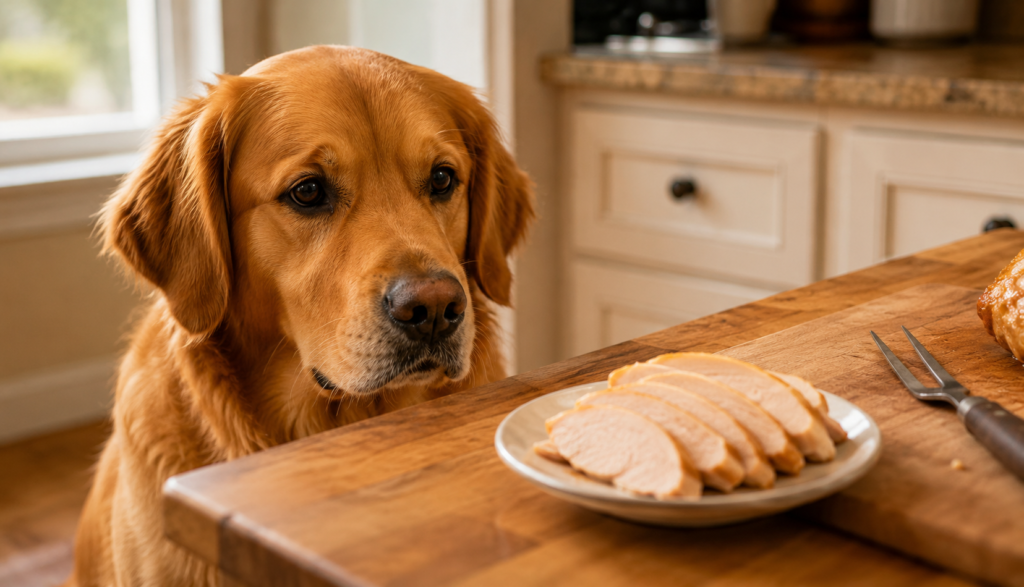
Every Thanksgiving without fail someone in my family sneaks turkey to the dog under the table, and every year I watch the same debate play out about whether that’s fine or genuinely harmful. The honest answer has always been “it depends on which part,” but that distinction rarely gets made in the middle of a holiday dinner. Turkey is actually one of the better human proteins you can share with a dog, appearing in commercial dog food formulas as a primary ingredient — but the same turkey sitting on your Thanksgiving table has been through butter, garlic, herbs, and hours of high-heat roasting that changes the safety calculation entirely.
Is Turkey Safe for Dogs?
I’ve seen this firsthand more times than I can count: a small piece of plain cooked turkey breast causes no obvious problem for the vast majority of healthy dogs. Turkey is genuinely one of the safer human proteins, appearing regularly in vet-recommended bland diets alongside plain rice for dogs recovering from digestive upset.
It’s a lean protein source that digests relatively easily, sits well on sensitive stomachs, and carries a nutritional profile that makes it genuinely useful rather than just tolerated. This is one of the reasons turkey appears so often as a primary ingredient in commercial dog food formulas.
The answer is a confident yes for plain cooked turkey. The conditions attached to that answer are what most of the rest of this article is actually about.
Turkey Skin: Why It’s a Problem
Most dog owners miss this completely, often because the skin looks like an innocent byproduct of the turkey rather than a separate concern. Turkey skin is where a disproportionate amount of fat content concentrates, and it’s usually where most of the butter, oil, and seasoning from cooking absorbs most heavily.
Feeding turkey skin regularly or in large amounts significantly raises the risk of pancreatitis, a painful and sometimes serious inflammatory condition of the pancreas that high fat meals are known to trigger in dogs.
Removing the skin before offering any turkey to your dog is a simple step that removes the biggest real risk from this food, leaving the lean turkey breast as the straightforwardly safe part underneath.
Turkey Bones and the Splintering Risk
The first time I dealt with this question from a reader, turkey bones came up immediately as a concern, and rightfully so. Cooked turkey bones are notorious for splintering into sharp fragments, creating a genuine choking hazard and a real risk of internal injury if a sharp piece makes it past the throat.
This is particularly true of smaller bones like rib bones and wing bones, which fracture more unpredictably than larger bones and are more likely to produce sharp splinters rather than clean breaks.
Raw turkey bones carry slightly less splintering risk than cooked ones, but even those should only ever be offered with direct supervision rather than left unsupervised with a dog, regardless of how experienced a chewer your dog tends to be.
The Thanksgiving Turkey Problem
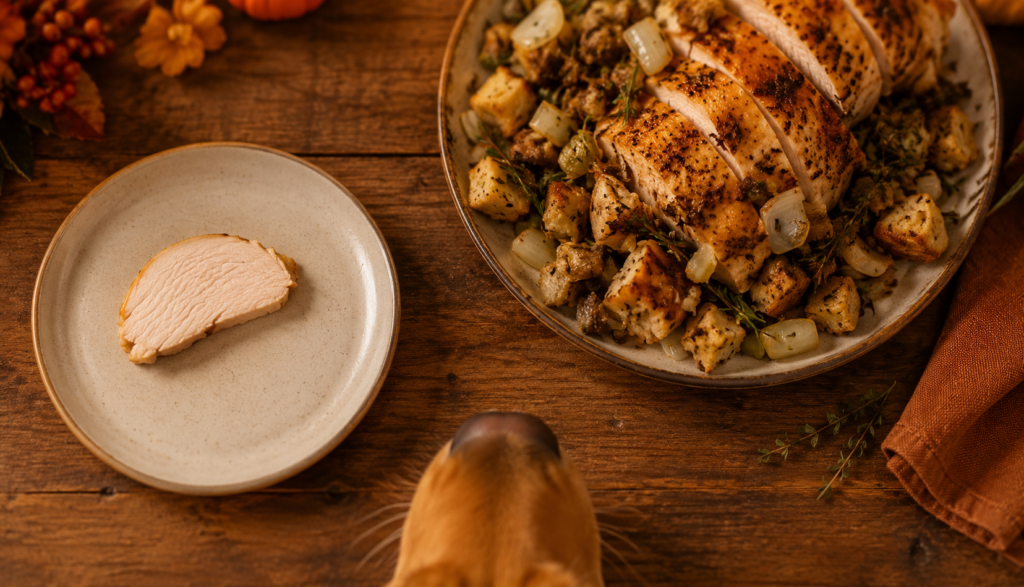
What surprised me was how often people assume that because turkey is safe, Thanksgiving turkey specifically is safe too. The issue isn’t the turkey, it’s everything done to it before it reaches the table. A typical Thanksgiving turkey has been seasoned with garlic, onion powder, herbs, butter, and various spice blends, all of which introduce compounds that range from harmful to genuinely toxic for dogs.
Turkey stuffing is a separate concern entirely, frequently containing garlic, onion, raisins, or other ingredients that have nothing to do with turkey and everything to do with what goes into a standard stuffing recipe.
The Thanksgiving turkey your dog is eyeing from across the room is a fundamentally different food from plain cooked turkey breast, regardless of how similar they look sitting on the same plate.
Turkey Lunch Meat and Processed Turkey
I’ve watched this trip up owners who assume processed turkey is a reasonable alternative to cooking fresh. Turkey lunch meat and deli turkey carry meaningful sodium content as a preservative, along with various additives and sometimes garlic or onion flavoring depending on the brand.
A small accidental bite of plain deli turkey isn’t typically an emergency, but making turkey lunch meat a regular treat introduces far more sodium content than a dog’s system needs, particularly for smaller breeds where even moderate salt intake adds up quickly.
Plain cooked turkey prepared at home, without any seasoning, remains the only version worth thinking about as a deliberate treat rather than an accident to manage.
What Most People Don’t Know
Here’s a detail that rarely comes up: turkey giblets, the organ meat package often included inside a whole turkey, are actually safe for dogs and nutritionally dense compared to plain muscle meat. Liver, heart, and gizzard are all commonly used in commercial dog food and dog treats precisely because of their concentrated nutritional value. Plain boiled giblets without any seasoning are a legitimate occasional treat that most owners discard without realizing they’re throwing away one of the more nutrient-rich parts of the bird.
How to Safely Offer Turkey
From experience, the smarter call is to always offer plain, skinless, boneless, fully cooked turkey breast with absolutely no seasoning involved in the cooking process. Boiling or baking turkey without any additions produces the cleanest version for sharing with a dog.
Portion size should stay modest, a few small pieces rather than a significant serving, particularly for dogs not already accustomed to turkey as part of their regular diet.
Ground turkey cooked plainly at home is another good option, especially for smaller dogs or puppies who benefit from a softer texture than solid pieces of breast meat provide.
Risks and Things to Watch For
Watch for vomiting, diarrhea, or an unusually hunched or painful posture after a dog eats turkey skin or a fatty portion, since those can signal the early stages of pancreatitis rather than simple digestive upset.
Any dog that gets into Thanksgiving turkey stuffing warrants closer monitoring, particularly if garlic or onion were among the ingredients, since toxicity symptoms from those compounds can take a day or two to fully appear.
If symptoms persist or worsen, a vet visit is always the right call, particularly any time seasoned turkey, bones, or stuffing were involved rather than plain cooked turkey breast alone.
Frequently Asked Questions

Q. Can dogs eat Thanksgiving turkey?
A. Not the seasoned version — Thanksgiving turkey typically contains garlic, onion, butter, and spices that aren’t safe for dogs, even though plain cooked turkey itself is fine.
Q. Can dogs eat turkey bones?
A. Cooked turkey bones should be avoided entirely since they splinter into sharp fragments, creating a serious choking hazard and risk of internal injury that isn’t worth the risk.
Q. Is turkey skin safe for dogs?
A. No, turkey skin is high in fat content and usually carries absorbed seasoning from cooking, both of which raise the risk of pancreatitis and digestive upset in dogs.